St. Croix Update: planning, partnerships, and why this market fits Wind Harvest
Tom Williams (VP of Operations) Ola Ajala (Principal Engineer), and Kevin Wolf (CEO) spent the week of Sept 8 immersed in strategic planning and collaborative meetings with local potential partners in St. Croix, US Virgin Islands. One highlight of the trip was welcoming DeKristie Adams as Wind Harvest new Senior Advisor for Key Accounts. DeKristie brings a legal mind, deep insight and commitment to the table—not only in her advisory role but also as a major investor in our work.
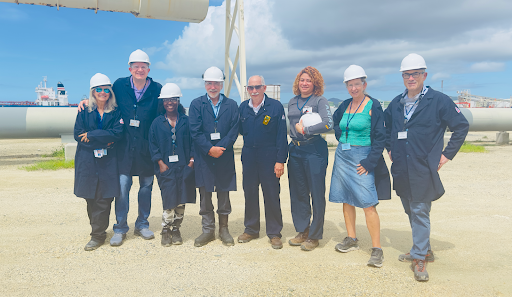
L to R on the west side of the Coke Dock Peninsula: Amy Dempsey (permit consultant), David Johnson (PHRT President), Ola Ajala, PhD (WH Principal Engineer), Kevin Wolf (WH CEO), Fermin Rodriguez (PHRT VP & Refinery Manager), Paloma Cepedes (PHRT), DeKristie Adams (WH-Advisor), Tom Williams (WH-VP Operations)
Key Takeaway:
St. Croix presents a compelling launchpad for Wind Harvests 2026 and 2027 deployments and a gateway to scaling industrial-grade VAWTs across the Caribbean. The island combines strong wind resources, elevated electricity costs, and highly motivated large energy users—all reinforced by stackable financial incentives such as Investment Tax Credit (ITC) adders, bonus depreciation and the tax benefits inherent to investing in projects in the US Virgin Islands. Together, these factors create a uniquely favorable environment for early-phase project success and long-term regional expansion.

Coke Dock Peninsula looking north
PHRT Collaboration
We are advancing the development of Power Purchase Agreements (PPAs) with Port Hamilton Refining & Transportation (PHRT) in support of their planned refinery restart, focused on producing lower-carbon jet fuel. At full operational capacity, PHRT’s continuous electricity demand is projected to reach approximately 65 MW—equivalent to over 500,000 MWh annually.
As a conceptual benchmark, this level of demand could be met by an estimated 200 MW of Wind Harvesters® deployed in array configurations (e.g., 50 kW-class units). This assumes a regional wind regime averaging 5.7 m/s (12.8 mph), yielding roughly 2,500 MWh/MW-year.
Wind Harvest is advancing discussions that could lead to the sale and installation of 60-80 MWs (1200 to 1600 50kW VAWTs) and another 60+ MWs of solar in projects that Wind Harvest helps develop and setup
The actual deployment would follow a phased approach, with each project structured to independently meet IRS eligibility criteria. This includes securing its own permits, interconnection agreements, PPAs, lease arrangements, and legal frameworks. Recent IRS guidance provides a clear pathway for structuring these phases to ensure compliance and maximize project viability.
Future blog posts will cover the details of how the projects can be financed, where they would be in the refinery grounds or nearby, the environmental steps that need to be taken to secure permits and more.
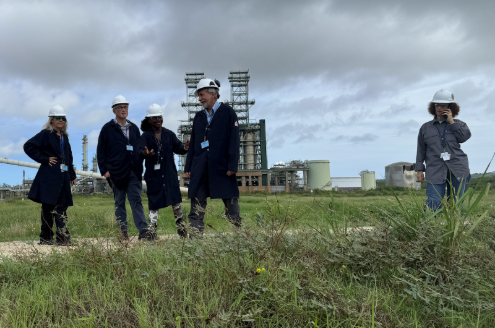
On the northeast side of the Coke Dock Peninsula next to the Landfarms where toxic sludge is still going through a biological treatment process. Amy Demsey,Tom Williams, Ola Ajala, Kevin Wolf and PHRT environmental specialist Catherine Elizee.
Contact: Jake Weatherman, Blog Supervisor – jweatherman@windharvest.com
Wind Harvest International, Inc. is a California-based renewable energy technology company, founded in 2006. The company makes, sells, and develops projects for its Wind Harvester brand of H-type turbines, the only known product designed to harvest the highly energetic, turbulent wind that blows 15-80 feet above the ground.