
Driveshaft and Bearing Housings – Ready to Go
Wind Harvesters are designed with the intended ability to operate in sites with wind blowing at over 50 mph. Because wind power increases with the cube of wind speed, and because our “cantilevered” VAWTs present approximately 1,800 square feet of rotor area to the wind, the resulting forces on the driveshaft and bearings can be significant.
Some of Wind Harvest’s early prototypes—and the classic Flowind “eggbeater”-style VAWTs—used structural connectors at the top of the central mast to limit side-to-side motion in strong winds. Cantilevered turbines like ours eliminate that top support. This delivers important benefits for rotor size, costs and energy capture, but it also means the driveshaft and bearings alone must absorb and control all those loads.
In Denmark, the driveshaft for our Wind Harvester 3.0 was designed before we had a validated computer model to predict harmonic resonance and the loads transmitted from the rotor. We soon needed to repair the driveshaft and then collect data to validate the VAWT aeroelastic model that Dr. David Malcolm brought to Wind Harvest when we hired him out of retirement. That experience dramatically deepened our understanding of driveshaft and bearing design.
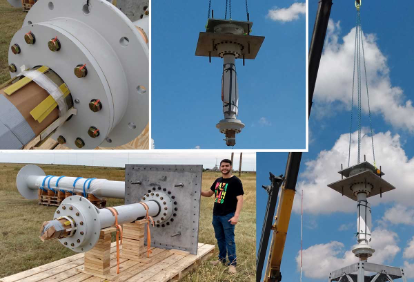
This is why we’re pleased to report that the pair of driveshafts for our two Wind Harvester 4.0 turbines have now been fully funded and are in the process of final manufacturing and pre-assembly at Tech-Max Machines in Illinois. With a combined weight of more than 3,000 pounds, these large, complex driveshafts and bearing housings are truly the backbone of each machine. Below are photos of the components in our Model 3.1 prototype in Texas where they worked according to our expectations.
Contact: Jake Weatherman, Blog Supervisor – jweatherman@windharvest.com
Wind Harvest International, Inc. is a California-based renewable energy technology company, founded in 2006. The company makes, sells, and develops projects for its Wind Harvester brand of H-type turbines, the only known product designed to harvest the highly energetic, turbulent wind that blows 15-80 feet above the ground.


